
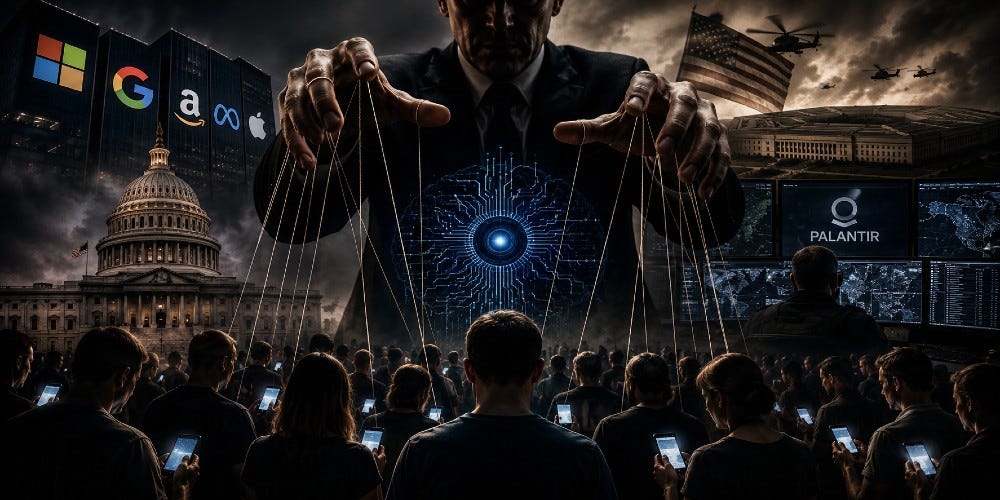
Strip away the science fiction and the stock hype, and the artificial intelligence story is an old one wearing new clothes. It is a story about power, who has it, who granted it, and who can take it back. Answer those three questions honestly and the picture that emerges should trouble anyone who still believes in government by consent.
Start with who has it. A handful of corporations now control the models through which a growing share of humanity asks its questions, drafts its words, and forms its picture of the world. Five tech giants alone poured more than 355 billion dollars into AI infrastructure in a single year, a private buildout with no peer outside wartime government spending.
Inside those companies, small teams decide what the models will say, refuse, emphasize, and bury. Those decisions ripple out to billions of users, and testing has repeatedly shown the results tilt in one political direction, with the model behind the world’s most popular chatbot presenting left-leaning arguments almost exclusively when asked contested questions.
Now ask who granted this power. Nobody. No statute created it, no election ratified it, no constitutional process blessed it. It accumulated the way power always accumulates when nobody is watching, through network effects, capital, and the slow migration of human dependence.
The men who run these companies sit atop something no Rockefeller ever held. Standard Oil controlled what moved your car. These firms increasingly influence what moves your mind.
The Government Is Not the Counterweight. It Is the Customer
The traditional answer to concentrated private power is public authority, but here the two are merging rather than colliding. Palantir, whose stock has risen roughly 1,700 percent in three years on the strength of government work, holds multibillion-dollar contracts across the defense and security agencies. Its chief executive published a book arguing that America’s future deterrence will be built on software, framing the matter bluntly with the line, “it is who will build them and for what purpose.”
Whatever one thinks of that argument, and there is a serious national security case for American AI dominance over China’s, notice what it produces at home. The state becomes structurally dependent on a private layer it does not control, staffed by men no voter can remove, holding data no citizen can audit.
Conservatives should feel no partisan comfort here simply because some of these executives currently make friendly noises. Power this concentrated does not stay friendly. It seeks its own preservation, and it will court whichever administration holds the checkbook.
The Founders did not design a system that depends on the good character of the powerful. They designed one that assumes its absence, and that assumption is the whole genius of the American order.
Put not your trust in princes, nor in the son of man, in whom there is no help. (Psalm 146:3)
The psalmist’s warning applies with equal force to princes in armor and princes in fleece vests. No man, however brilliant, and no company, however innovative, deserves the kind of trust now being casually extended to the owners of these systems.
Trust belongs to God; toward men wielding power, the biblical posture and the constitutional posture agree, and that posture is vigilance.
What does vigilance look like in practice? Congressional oversight with subpoena teeth rather than photo-op hearings. Transparency requirements for models embedded in government functions. Vigorous competition, including open-source alternatives that break the chokehold of the few. And a citizenry that keeps asking the question this entire industry would prefer to skip. Who elected you?
Suggest the LXX Brenton translation
Trust not in princes, nor in the children of men, in whom there is no safety.